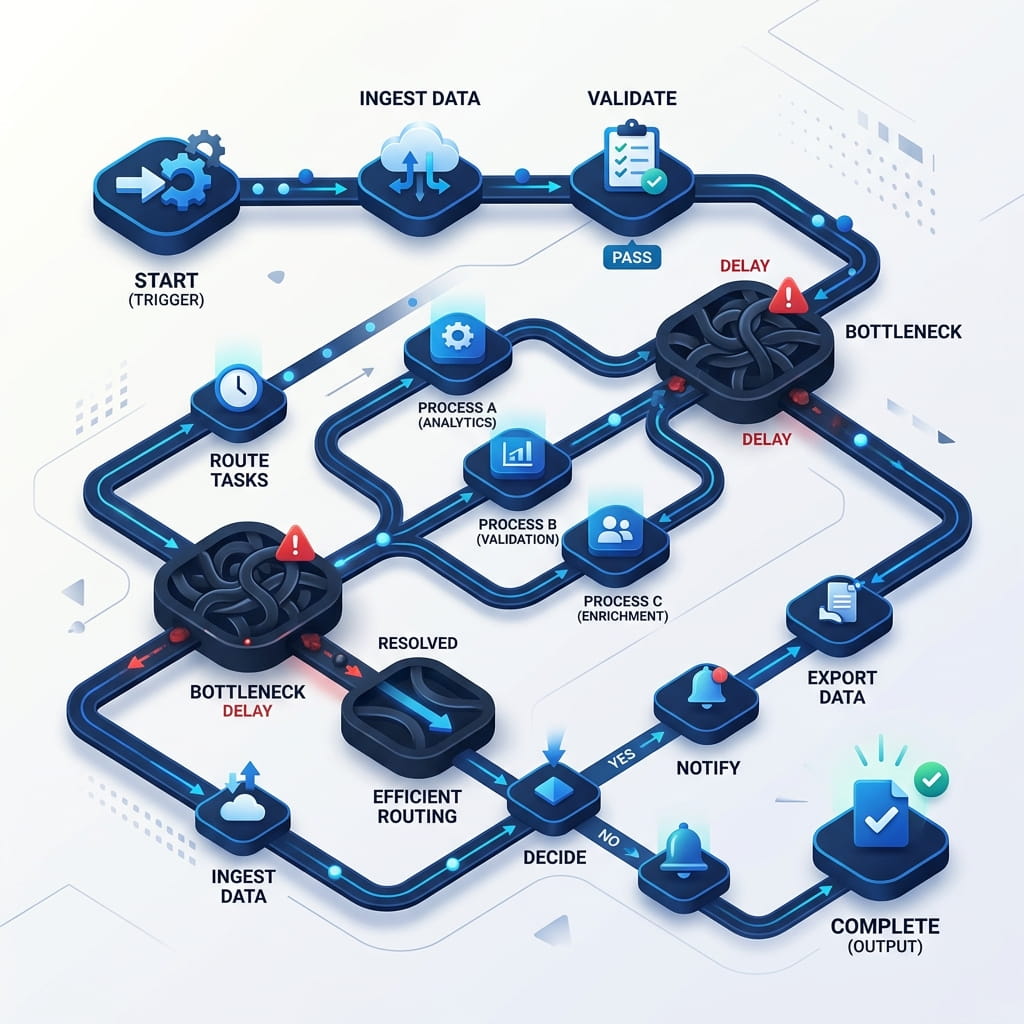
In most document-driven companies, operations run fine—until a document needs to travel between departments. An invoice gets stuck on an out-of-office manager's desk; a vendor contract undergoes three conflicting redline versions via email; a new hire sits idle because their signed onboarding packet is lost.
These delays are not caused by employee incompetence, but by structural flaws in document workflows. Below, we look at the 5 most common document bottlenecks killing productivity, and how you can eliminate them.
Sending files as email attachments for review is a recipe for delay. Feedback gets buried in separate threads, and managers forget to respond. Modern automated systems solve this by keeping files in a central task list with automated reminders.
When multiple stakeholders download a document to make edits locally, it creates version fragmentation. No one knows which copy contains the true final clauses. A unified DMS keeps a single file version history log, locking files during editing and tracking changes chronologically.
Staff members spend hours typing "Hey, did you have a chance to look at this purchase order yet?" to their managers. Status follow-ups should be mechanical: if a file has been pending review for over 24 hours, the system should trigger a nudge notification automatically.
If an approval workflow has a linear chain that halts completely when a single executive is away, it stalls business operations. Workflows must have routing rules (e.g., if a manager is out, route to an assistant or auto-escalate the request) to keep document pipelines moving.
Approving files verbally or via Slack chat messages makes it impossible to verify approvals during a compliance check. Approvals must be recorded directly on the document metadata container, securing a permanent validation footprint.
How Automated Triggers Drive ROI
Transitioning from a manual pipeline to digital workflows does not just clear bottlenecks; it creates huge productivity returns. By establishing structured pathways (Forms canvas → Automated AI Tagging → Review Chain Notification → Cloud Archival), companies typically reduce approval turnaround times by over **80%**.
When you are ready to design the path itself—trigger, routing, SLAs, and the audit trail—use how to build document approval workflows and TurboWorkflow.