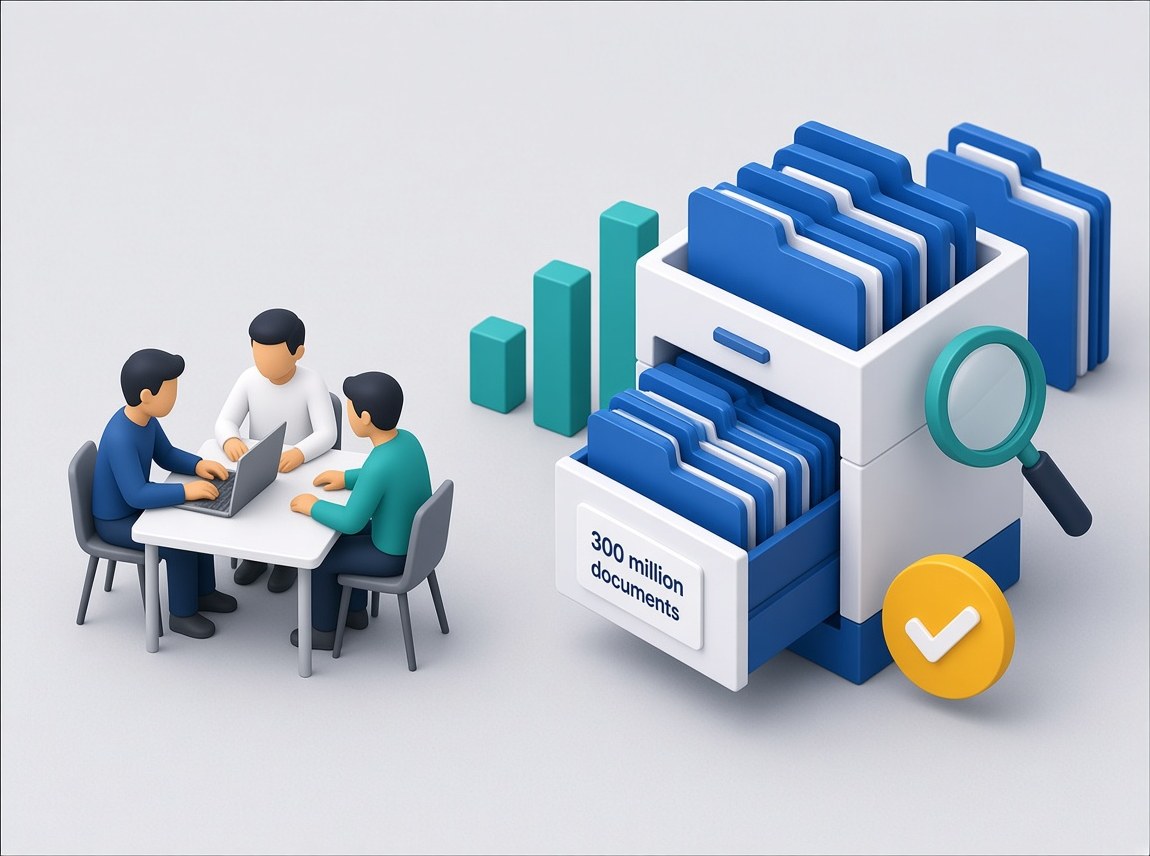
Shared drives feel fine at a few thousand files. They get slow, and hard to trust, long before a company has decades of contracts, scans, and employee files. TurboDMS is built for that later stage. In November 2026 we measured a single library of 300 million documents under the load of 600 people working at the same time.
"300 million documents. 600 people at once. 95 out of 100 requests to everyday screens finished in under half a second, with no errors."
TurboDMS scale test, November 2026Summary of the result
- Library size: 300 million documents in one library, loaded before the test began. At a typical 2 MB per file, that is about 600 terabytes.
- Concurrency: 600 people active together.
- Response time (95th percentile): under 0.5 seconds on every everyday screen measured.
- Errors: none returned by the product during the run.
The question we tested
The test did not ask whether the disks can hold that many files. It asked something more useful: can someone still open the product and do a normal day's work when the library is that large? We measured the screens people open every morning: home, a department folder, a year, a month, a folder of files, a name search, tasks, and reminders.
How we measured
We state the method so the numbers can be read in context. We keep the infrastructure private, as any vendor would, because the result should stand on how the product behaves, not on a hardware list.
- Starting state: the library was already at 300 million documents before any user activity began.
- Load: 600 simulated users worked at the same time. Each one opened a screen, read it, then moved on to the next action, the way a person does.
- What we recorded: the response time of every call, and every error returned by the product.
- How we report it: as the 95th percentile (p95). A p95 of 0.5 seconds means that 95 out of 100 calls finished in 0.5 seconds or less. It describes what users actually experience, not a best case or an average that hides slow requests.
- Growth: we ran the same kind of test as the library grew, from tens of millions of documents up to 300 million.
What we measured
| Screen | p95 response time |
|---|---|
| Home | under 0.1 s |
| Folders, including a folder of files | about 0.1 s |
| Search by name | under 0.5 s |
| Tasks and work lists | about 0.5 s |
Across the whole run, nothing returned a product error. As the library grew from tens of millions of documents to 300 million, the everyday screens did not get slower just because the count got larger.
Measured, and projected
We keep the two apart on purpose.
- Measured: 600 people active at once in a library of 300 million documents.
- Projected: in a normal organization only a fraction of the team is in the product at the same moment. A load of 600 simultaneous users is what we would expect from an organization of 5,000 people or more. This is an estimate based on typical usage patterns. We did not test 5,000 named users directly.
What this test covers, and what it does not
This was a test of everyday reading: home, folders, search, and the lists people check. It is the right test for "can the team still work." It is not a claim about a one-off report that walks the whole library. Those jobs take longer by nature, and they are not the page someone opens to find this morning's contract.
Results depend on your files, your network, and how you deploy. Cloud and on-premises are both supported, and your own times will vary with them. The shape of the result is what matters: a library of hundreds of millions of documents, on the order of 600 terabytes at a normal file size, with hundreds of people in it at once, and the morning's work still quick.
Why a shared drive is different
At this size, finding a file by its folder path is already a project. Search, permissions, and a record of who opened what are the difference. Version history, role-based access, audit trails, and search stay on the document as the library grows, so you do not split "the files" and "the control" across two products. We describe the same gap in document management vs shared drives.
Check it against your own library
If you are sizing a rollout and want more detail on the test, contact us and we will walk you through the method and results. You can also see how the product fits your team on the features page, or review pricing. The Enterprise plan does not cap the number of users.