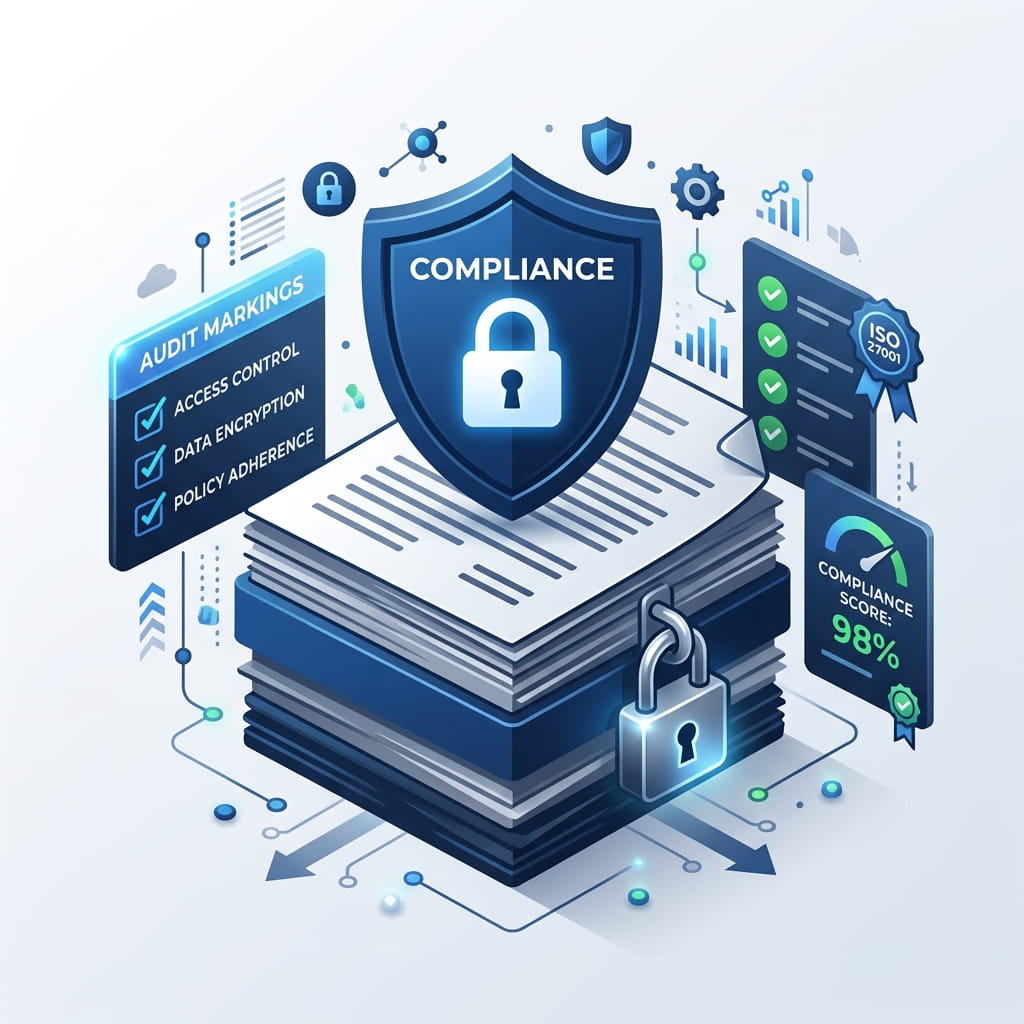
For organizations operating in regulated sectors—such as legal services, healthcare, finance, or corporate auditing—document security is not just an IT checklist item. It is a critical layer of regulatory compliance and data protection. A single leaked contract or compromised patient form can lead to severe fines and irreparable loss of client trust.
Building a secure document management environment requires moving beyond generic shared folders. In this guide, we break down the core components of modern document compliance: encryption standards, role-based access, and tamper-proof logs.
1. Encryption: At Rest and In Transit
Data encryption ensures that even if files are intercepted or raw databases are breached, the contents remain completely unreadable.
- Encryption in Transit (TLS 1.3): When a document is uploaded or downloaded, it is packaged in a secure cryptographic tunnel, preventing "man-in-the-middle" eavesdropping on public Wi-Fi networks.
- Encryption at Rest (AES-256): Once saved to cloud storage, documents are encrypted using the Advanced Encryption Standard with a 256-bit key. This standard is identical to the protocol used by federal agencies to encrypt top-secret records.
2. Role-Based Access Control (RBAC)
Security is as much about managing internal workflows as it is about blocking external hackers. **RBAC** ensures that staff members have access only to the files necessary to perform their roles (the "principle of least privilege").
Instead of setting folder-by-folder password sharing, files are managed under global user policies. For instance, billing teams can read and write `Invoices` but are blocked from viewing `HR Employment Contracts`, while general auditors can only view (read-only) files without edit permissions.
3. Tamper-Proof Audit Trails
If an auditor asks: "Who accessed this sensitive file, and did anyone share it outside the organization?", you must have an answer immediately. An audit trail logs every single document action automatically.
A compliant audit log record tracks:
Timestamp + Document ID + User Identity + Action (View/Edit/Share) + IP Address
In a secure platform like TurboDMS, these logs are append-only and cannot be modified or deleted by general administrators, preserving their audit integrity.
4. Preparing for Regulatory Audits
When preparing for SOC 2 or HIPAA audits, you will need to demonstrate active security policies. A modern DMS saves hundreds of prep hours by automatically organizing version histories, providing centralized RBAC lists, and compiling access log sheets in one click.